
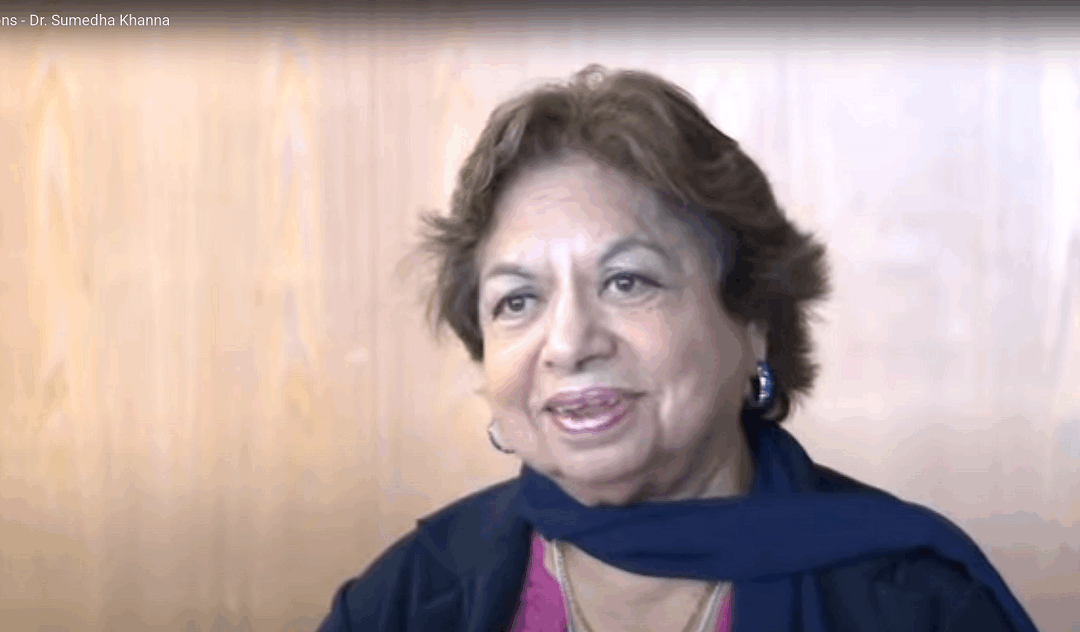
Reflections
with Dr. Sumedha Khanna
I shifted from the care from one-on-one to one like a physician does, you know, taking care of one person at a time from Clinical side to the preventive side and that was so much more satisfying than just doing clinical work. The social and political challenges of our healthcare are so, so much more important than just only providing the one-on-one healthcare.
“The health of the people,
The people of health”
I think I knew from as a child when I was only 3 years old, that I wanted to become a doctor. I don’t know how, but I just wanted to be a doctor so there was no other profession for me, so I went straight for it and I qualified as a physician.
I did my first degree before I was 21 one and then I went to England to specialize in Obstetrics and Gynecology, which was the field I wanted to work in but then, after working for several years, I felt that I needed to learn more about the social aspects of obstetrics, not just the clinical side, because clinical side I could manage but why do – especially coming from a country like India, where I come from originally – I used to see many women come very late in their pregnancy with a lot of problems and sometimes you couldn’t do anything for them so I wondered why is it that the women die during childbirth? Why did the baby die? So, what are the factors behind that?
So that motivated me to move into the social side of Obstetrics, which brought me to United States and I did my public health degree, then master of Public Health from University of Pittsburgh. And I still wanted to do both the clinical and the preventive aspects of maternal health and also the Family Planning, which was the very active field in the 60s, late 60s. I was probably one of the first obstetricians and gynecologists trained completely in the field of social maternal Health and Family Planning techniques. And that was very rare in the mid-60s, late 60s.
That’s what happened with the coincidence of PAHO and me because I was working at Columbia University in New York and PAHO had its first Pan-American Conference on Population Dynamics in Venezuela, Caracas, that was in 1967, and that’s when some of the countries asked the Director of PAHO, was Dr Cutler it was Dr Horowitz, sorry, if they could get some technical assistance in starting training their doctor nurses, starting some clinics and their population program, maternal and child health program, and it just so happened that I was in the area and there someone who was my boss from Columbia University, was attending the conference with Dr Horowitz and he said I know just the person who can do this. So Dr Horowitz wanted to see me, he interviewed me, and he asked me if I would like to go to the Caribbean for two years, and starting in Trinidad, to help establish their National Family, National Population Policy to train their doctors and nurses in Family Planning techniques, and start their Clinics. Of course I jumped! I loved it!! So that’s how I ended up starting with PAHO. It was just one of those things that happens – probably once in your lifetime that the right people are there – the right people and you have somehow fit the bill. So, I started in Trinidad and then worked in the Caribbean, all the rest of the Caribbean, as an advisor in Maternal and Child Health, and Population Management.
That’s how I got into PAHO, but that was the time when other agencies were also starting population programs, so the World Bank asked me if I would go with them, the United Nations asked me, and Dr Horowitz didn’t want me to leave PAHO. I also felt I should go back to Columbia University, but he said, ‘You stay in PAHO because we want you here.’ and I said, ‘I finished my work that I came to do in Trinidad, so I think I need to move on.” And he said, “Well, you can take any job you want.’
I was working with the Maternal and Child Health Programs in Guyana and so the Minister of Health of Guyana wanted me to come to her country to help develop some rural training programs for auxiliaries and develop the national health plan, so I was interested. So, I asked Dr Horowitz if I will go to Guyana as a country representative and he said, ‘No, no we can’t have a woman as a country representative. We’ve never, never had a woman as a country representative.’ I said, ‘Well, that’s not my problem, you know, it’s you. You wanted me to know. I’m not asking for a job but if you want me to stay, that’s the country that interests me. Dr Candau, The Director-General of WHO, was not in favor of that because he said, ‘No, no, no, we can’t have a woman there.’ but Dr Horowitz went ahead and appointed me on the objection of Dr Candau.
I had to learn, how do you become a kind of an outsider, but still a technical support, technical assistant, in a country without taking over the work yourself. You know, how do you shift – how do you train local people and how do you transfer knowledge, and that’s something, you know, you don’t learn as a doctor. You just – but so my very first time when I talked to Dr Horowitz and I said, ‘How will I?’ and Dr Gerald who was a [?], ‘How do I do this job well how do I transfer this knowledge and how…’ – and, and they said you have to work yourself out of your job. That’s your job. That means find the person there, train them, and you become, you know, you, you’re out of that job. So, you work yourself out of your job. And that goes – I’ve never forgotten that, because the idea is that we’re not there forever. We are there to transfer skill, transfer knowledge, prepare the local leadership and move on. And so that had – it never forgot, it never left me.
That’s why I worked very closely with people whenever I go and I try to learn their language, so that I can actually work with them, not as an outsider, but I don’t do the – I shouldn’t do the job that they are supposed to do, you know. This is a very – and at the same time I shouldn’t be just sitting outside and hoping things will change, you know. So it’s a subtle, political, and technical combination of political and technical skills. So that was my big impact. And I think the country where I worked, which had the biggest impact for me was Guyana. It was a – it’s a very simple country. People were extremely receptive, and I learned so much because it was just very basic, and you had to work with people. I would go out to the field. I would do some, you know, real research on – as a country representative I wasn’t just doing office work, because those were the days when you didn’t have so much paperwork, you could actually go out. And you also were technical expert, so I would go out in the rural areas and work with – and learn about – what the real health problems were. And actually then prepare the training materials. And the people I was working with were just so genuine, and so receptive, and so encouraging that it was one of the, I would say the one of my best – if people ask me what was your best time, I think that was my best assignment, best time, because it had the biggest impact on me.
I got a feeling of satisfaction that this is what I came here to do and when I left it, I was able to do something Dr Horowitz asked me to come to Washington, DC to the head – to west PAHO headquarters at the – in the population health and population division as the Deputy of that Division and Chief of program and evaluation. That’s when I got the rest of the South America as well, so I was working in every country developing some aspects of Maternal Child Health, Population Dynamics program, starting new projects and then I also um – that was – that it was also very challenging, but I learned a lot of Spanish and it was just wonderful to work in so many different countries. I think I worked in every country except Paraguay. I’ve done something in every country.
Then I went – I asked – I wanted to go back to the field again because I really like the field work more than headquarters, so I um Dr. Acuna became the director at that time and he wanted me to continue, but I said I would like to go to Jamaica as the – I love the Caribbean so and as a country representative for Jamaica and the Western Caribbean. So he – he appointed me there and then, because before that he asked me to do a study of the Caribbean region to see how best PAHO can serve the Caribbean country. So I did that – that study and made a recommendation that they set up an Office of the Caribbean program coordinator in Barbados and he wanted me to go there as the Caribbean program coordinator, but my recommendation was that they should appoint a Caribbean person for that because it – it’s important for the Caribbean people to see their own person in the leadership position not me.
And so he said well I was hoping you’ll take that but I said no I’ll go to Jamaica instead. So I did that for 3 years and then Dr Acuna wanted me to come back here as the Chief of the Division of Comprehensive Health Services with – because the division was in a big trouble. There was a lot of vacancies, a lot of personnel problems and – and he was reorganizing so I came here as a Chief of the Division of Comprehensive Services.
Can you tell us about your transition from working at PAHO to working at the
World Health Organization?
I went there as the Deputy to the Health Policy um for Health For All by the year 2000, because they had just approved – approved that goal and it was question of how do we make that goal work in the countries? How do we translate the goal into action? So Dr
Mahler invited me to come and join that Health For All group and at – under him
and at the policy level to see how we can get this goal functioning and so my first job was evaluating the 120 countries at that time, how they were progressing in making this happen, but there wasn’t really anything happening much at that time.
So we – so I then became the Director of the Health For All Strategy Coordination under Dr Mahler – under the Director General. Very high honor at that time and I think my biggest program was the Developing Leadership for Health For All in all the countries of the world. And so, I was the starting – I was the founder of that program. I designed that program with colleagues from staff development, colleagues from Human Resources Development and did a very… – because that was the one of the biggest challenges for
me was – how do you get – how do you develop leadership. People are in leadership positions, but how do you make them into real leaders so that they can see the problem, communicate about the problem, develop strategies, and not just, you know, be political leaders.
So that’s – I did that for five or six years and then the political change took place
in WHO, also with the new Director General who was not that interested in leadership program. I think he was very much more technological oriented, and my feeling was I wanted to go back to the field again I don’t want to play politics you know, so I asked for a country representative assignment, either in China or India – or Indonesia. I couldn’t go to India because I’m from India. And somebody had been appointed to China so uh the Chinese government wanted me, but they already had one, so I WHO went to Indonesia. I wanted the largest program of WHO, which was in Indonesia and India.
So, I – that was a wonderful assignment! Another wonderful leadership and I was there for five years. even though they sent me for three, but the government didn’t want me to leave and I loved it anyway. So, after that – so that was a big – and I also had some other duties with the non- aligned countries – the health section of non-aligned countries and with the leadership development of the Asia Pacific region. But then Dr Nakajima wanted me to come back to headquarters as a “chef de cabinet” for his – when
he was re-elected and I didn’t want to go back to Geneva in that political environment again and I – I was getting tired. 25 year plus, moving about, and I said you know I think I need to rethink now. I’m still young enough to think what I want to do with the rest of my life. I don’t want to just spend another 5 years and then retire and then don’t know what to do so – and my husband is from America – so we came here. I took early retirement and came here and went through another transformation in my life in my career, professional life, because then I started studying different systems of healing. I wanted to learn how to integrate other systems into our clinical systems. I didn’t want to just become another clinical practitioner in California, which is where I live.
So, I spent about 3 to 4 years learning all the different systems of healing and integrated everything into what I call my healing center, called The Healing Well, which was kind of for Women by Women, and bringing them together to learn to integrate daily practices and Body Mind Spirit practices to keep themselves healthy and prevent health problems. So, it was again a combination of prevention, self-care, awareness, and consciously working with yourself.
So that’s what I do now, but I’m doing that now with the older woman, women 60, 65, and over. As I get older, I see different problems with the older women, so I shifted from the midlife to the older women and I still do that work with the challenges, both Body Spirit Mind practices that we experience as older women and how do we learn how to do this, by learning from each other, and also learning some new practices. So very satisfying work. Different. So I’ve kind of reinvented myself again.
What did you learn from PAHO and what did PAHO learn from you?
What you learn, when you’re working in PAHO, is your institution like that you can’t learn it anywhere else you know. It’s just the – gives you the opportunity to real life situations in the countries, to meet and opportunities to develop skills, that we as doctors don’t develop. We don’t have very good skills in communication. We don’t have skills in dealing with political and social issues. We tend to be very, you know, compartmentalized – its nice people coming to the hospital to take care of them. So, learning how to – how to communicate with the community and how to communicate with the leaders in this, it was – it’s a fantastic opportunity. It’s a great learning institution.
What I think I contributed is what I learned, you know. I feel I contributed most of the National Population Family Planning Programs and what started when I was there, during my period. So large projects, both in Mexico, the evaluation of programs in Chile, Argentina – even review the Primary Health Care system in Cuba… I was very much involved and engaged in some of these very large programs, and I would say that I probably was the first person who started some of these Family Planning and Population Dynamic Programs and brought in quite a lot of resources from the United Nations, from World Bank. And so, I was good at making projects and getting money. I was very good at that.
When I joined PAHO, there were not very many women in the professional field, you know. It’s – so it was – I open the minds of the people, you know, especially here to have more women come in, because there was always, at the professional level, and know – when my division had several vacancies and we interviewed, you know, as usual we go through the process of – selection process. But generally, the feeling was well if you interview well, she – I don’t know how she’ll work and she doesn’t have the experience and – but I had to convince people we have to take the risk because if you don’t get them, you’ll never get the experience. How do you get in – get the experience unless you join. So, it was very good – I think so many women professionals that came because I was there and I think that I opened the door for more women to become – now be a woman director and another woman director.
So, it’s a very satisfying thing for me to see that, you know, just – it’s a wonderful thing because there was a lot of challenges for women before.
What advice would you give to the new generation of public health workers?
I think they have an advantage that they have access to fantastic technology – communication technology. So they have to see how they can put this technology to use for people, to help people in – in – right out there in the field; that this is one way they can – because they love technology, the new generation, and also I think they need to learn how to work with the – they need to prepare themselves to work with the social and political leaders, you know. How do you communicate with them. How do you learn
the policies. How do you learn the social challenges, not just the, you know, methods and procedures. They’ve got to be better communicators and so communication is a big, big issue here, and both use of technology.
And I think that basically not much has changed. Public health issues are still there. I mean they need to learn how to make programs – good programs that can get – our people have access to and how to get people involved much more. It’s a much broader type of role than when we used to have, you know, Communication Disease Expert or Maternal /Child. It’s not as compartmentalized anymore.
Final Comments
The best time of my life was the 15 years I spent in PAHO. PAHO is my home, literally. I still – you know you have so much affinity for this organization because this is where I grew up, I would say. And this is where I grew up both in my knowledge and my professional work. And I’ve had these most incredible leaders and mentors here. And when I come and see – today I saw three or four people who recognize me still and it’s just a wonderful feeling. So I think I’m so glad that the PAHO Staff Association, you know, is trying to keep this thing active so that we – I stay connected to see pictures of my colleagues. The saddest part is when you see somebody passed away, but that’s what’s going to happen to our generation eventually.
Every time I get a newsletter, I see two or three more people have gone and that makes me sad, but it’s like family, you know. It’s like PAHO is a big family for me. It always has. It always will be.
First published on PAHO TV: https://www.youtube.com/@PAHOTV
Recent Comments