
Solo Ageing
(Part 2)
By Sumedha Mona Khanna
In the March issue of the AFSM newsletter, I defined the meaning of solo ageing and identified five challenges of Solo Ageing. In that article, I addressed two of these: Financial Management and Security until the End of Life, and Good Health and Wellbeing to Function Independently. This article addresses an additional three challenges.
1. Finding Meaning and Purpose
Who one is now is an important question when one loses one’s life-partner or companion, especially after a long period of sharing a life together. Everyone is born solo, but when one is in a partnership with another person, especially over a long period of one’s life, one constantly adjusts and changes one’s personality, views, and ideas to maintain a happy and balanced relationship. Women must do this more often than men, especially if the man has also been the “provider” for the family.
In solo ageing, one must literally create a new identity for oneself, an independent one in which one learns to live solo, one with which one will be happy and engaged in what one loves. This is a challenge for many, especially if one did work independently and thus did not create one’s own identity. One may have to literally rediscover or redefine one’s own values and pursue life in response to one’s own needs and desires. This can be very challenging especially for older women.
An interesting and useful exercise is to list several values that have personal meaning. Then rate at least five of them in their order of importance. An important question one must ask is: “What really matters at this stage of one’s life?”
Everyone needs a reason to get up in the morning and be glad to still be alive. This is even more important for Solo agers. One must find a new identity as one ventures what is most probably the last and most precious phase of one’s life.
Taking care of oneself – healthy diet, physical and mental wellbeing, and finances, among other things, is imperative to ageing well. But for Solo Agers, another important question arises – “How to find meaning/purpose in life alone at this phase?”
There are many opportunities these days to remain engaged in life purposefully and meaningfully. One may start a new home-based business – there seem to be plenty of opportunities for this (especially during the pandemic years). Today’s technologies make home-made business more possible and viable than ever before. One can even make some money for daily living if one needs that.
Another way to find a purpose is to find a neighborhood community organization with which one can connect, such as volunteering with a local food service organization, participating in opportunities to connect with isolated older people through a local senior center, or even teaching children who have difficulty learning in a school setting.
Writing a memoir can be a very engaging practice. One may leave a legacy for loved ones – children, siblings, or friends. One way to deal with old photographs is to make a story-album of one’s life journey. Today’s technology helps us to make legacy box or legacy journal. It is also an excellent way to live through one’s old memories of life as well as to get rid of old stuff in boxes that one may never otherwise visit in this lifetime. And after one is gone, it removes the guilt from those who have to destroy them.
Talking about clutter – who doesn’t have that? One engaging activity (even though at times boring) is to use one’s spare time productively to go through boxes of old correspondence and papers that have no use at this stage of life, find a shredder, and get rid of them. It is a very purposeful way of spending one’s spare time and lightening one’s load. Who else will do this? I did that during the first year of my solo-ageing and found myself purposefully occupied, reliving some of the happier moments of my life, with some laughter and some tears, as though I was spending time with my beloved life-partner sharing moments of our lives together. This is a very healing exercise and helps one to move on with one’s own life.
2. Maintaining and Creating Relationships and A Strong Social Network
“Everything of value that we will know in this life comes from our relationships with those around us. There is nothing material that measures against the intangibles of love and relationship.”
R.A. Salvatore
Social isolation is one of the common issues one encounters among Solo Agers. In relationships, the strongest connection in our social network is our life-partner. When we lose that person, staying socially connected can be challenging. Even if there are children, by the time one is in one’s seventies or eighties, one has grown up, may have children of one’s own who often have moved away. Even when they might live nearer, they have their own lives and work and may not be easily accessible.
Everyone is different, some are married, some never were, some have no siblings so no nieces or nephews, some have children, and others have none. So, the challenges of social connection can be different for every person.
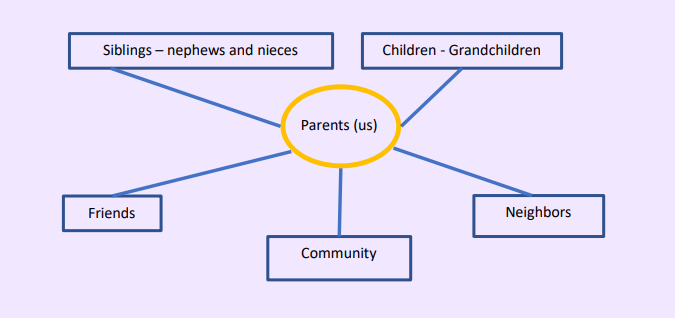
Basically, one’s typical social network, especially if one is a parent, includes:
The typical social network of a Solo Ager (without children) may be:
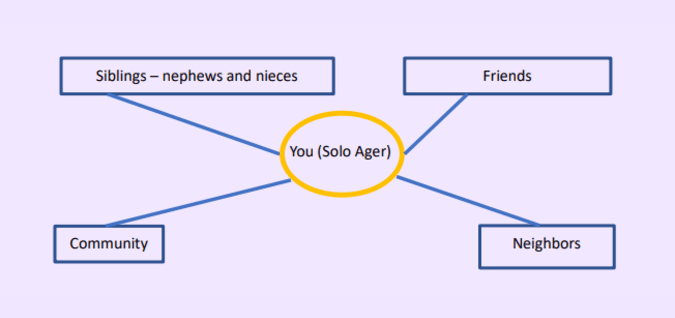
As a couple, one’s relationship forms with other couples, or colleagues that one meets at work. As Solo Agers our social network changes – generally the couples one once knew drift away and one also may find it awkward in company of other couples. One then needs to form one’s own social network with friends who have similar values and Siblings – nephews and nieces Children – Grandchildren Parents (us) Friends Community Neighbors Siblings – nephews and nieces Friends You (Solo Ager) Community Neighbors interests and who will provide emotional support if one needs help. This can be challenging, especially if the social network has been predominantly with one’s friends at work or with neighbors with whom one has been friends for a long time. Older people often move away to be closer to their children. It is therefore important to have several friends in one’s immediate social network.
Other ways to avoid social isolation is to find community groups in one’s neighborhood that may have common interests such as writing, book-reading, animal walking, art, and crafts. Joining one that is of interest may help in forming new friendship as well as in engaging in activities that have personal meaning.
Often a local community college or a similar institution offers a Lifelong Learning Program for seniors. They are affordable and provide an opportunity not only to engage one’s brain and keep mentally active, but it may also help to form connections with like-minded people with whom new friendship might form.
Travel groups with like-minded seniors can spark great friendships. Road Scholar is one such tour company that serves only older adults. It offers excellent opportunities for travel and meeting like-minded persons who can become part of one’s social network. “My SOS Family” is another company that for a small monthly fee can link people one chooses (up to 5) who one can call during an emergency if needed.
One’s social network is one’s family of choice. It should surround one with people one wants and who will be available when one needs them no matter what the time of day; people who can support one in living a happy life. Strong evidence exists that there is a direct connection between social support resources and one’s mental health. Social isolation for older people, especially for Solo Agers, can be very detrimental to health and wellbeing. It is imperative that one consciously forms a reliable social network to avoid social isolation.
3. Ageing in Place
Where then shall one live? This is one of the common questions that come up when one loses one’s life-partner, or when one is not working in a regular job. Everyone wants to be able to live in one’s own home in the older years rather than moving into a senior residential community. This is what I call Ageing-in-Place. Some people may not have that choice, especially if one has mobility challenges, does not drive, or has health challenges that require closer attention.
When one loses one’s life-partner, one might find the home that one shared over a long lifetime no longer serves. It may be too large or too old, it may require frequent maintenance, or it may have challenges if one has mobility issues (e.g., too many stairs or areas with difficult access). One might have financial constraints in keeping this house or in managing the maintenance. If one is not driving, then the location of the house closer to essential services is imperative. In some places, volunteer driving services may be available, but they are not always convenient. The neighbors who had become one’s close friends over the years might have moved away. It is hard to form friendships with new and often younger neighbors when one is an older adult living alone.
It is important to make the decision early in life when one is still mentally, physically, and financially capable, about where one wishes to live in one’s older years, especially when one is a Solo Ager. Often, one leaves this decision until too late, as it may seem challenging, and then others – one’s children or siblings/nephew or niece – might have to make that decision. Such a decision may not fit one’s needs and desires. This was one of the most important decisions that I had to make when my life-partner died. I needed to move to a smaller and more conveniently located house closer to my friends and to community services. Fortunately, I was in good health and had no mobility challenges. Yet, even now as I get older in my solo ageing years, I am conscious that I may have to move even closer to some services and maybe to be near at least one member of my extended family – a nephew or a niece.
Moving entails getting rid of all the things that have no purpose now in one’s life. Some of these may be precious with happy or special memories attached. It is better to give them away to people who will care and love to have them rather than being sold as junk. I have been to several Estate Sales that have brought tears to my eyes. So many precious and loved possessions being literally given away at such sales. Often antique shop owners take them and sell them at profitable prices. Going through one’s collections can be very emotional; it brings back memories of a life-together. It is better to experience that and then part with them, hopefully sending them to a place where they might also be cherished. Everyone collects too much stuff in one’s lifetime, especially if one’s work has involved travel. Though one has enjoyed them, it is time to lighten one’s load and free oneself – an important challenge for Solo Agers.
Everyone wishes to stay in one’s own home in one’s older years. But there may come a time when one might consider other options, such as a senior residential community with or without continuing care options depending on one’s health and other needs. As the older population increases and more people are living alone, the availability of such facilities and communities is also increasing. Some newer ones are quite progressive and comfortably livable. It is a good idea to do some research on this while one is still capable. One might find some that would be suitable to happily live out the remaining years of one’s life and in company of others who may be similarly challenged. For many Solo Agers, it might be a more convenient and acceptable option at this stage of life.
Concluding Comment
Most of us are headed for a Solo-Future in the older years. It’s never too late, or too soon, to develop a plan to protect one’s independence and make sure that this precious phase of one’s life will be happy, healthy, and meaningful. When it comes to ageing, one can’t always count on one’s children, especially if one doesn’t have any. I hope that these suggestions, based on my personal experience as well as that of some of my friends who are Solo Agers, will be helpful. Comments, suggestions, and other ideas are most welcome. Let us start a dialogue building on our experience and observations.
(Part III of this paper will focus on some personal stories about our experiences as Solo-Agers. We can all learn from each other’s experience. You are invited to share your story.)
References:
1. AGEING ALONE – A Candid Guide to Money, Health and Living for Single Seniors – Ruth Alvarez; 2017, Canyon New Media
2. ESSENTIAL RETIREMENT PLANNING for solo-Agers – A retirement and ageing roadmap for single and childless adults – Sara Zeff Geber, PhD, 2018, Mango Publishing, Coral Gables, Florida
3. RETIRING SOLO – Plan to Be Happy, Healthy, and Independent in Years Ahead – Lori Martinek; 2016, Published by Herlife Publishing LLC
First Published in the Association of Former PAHO/WHO Staff Members Newsletter: VOL XXXIII, No.2 July 2022
Recent Comments